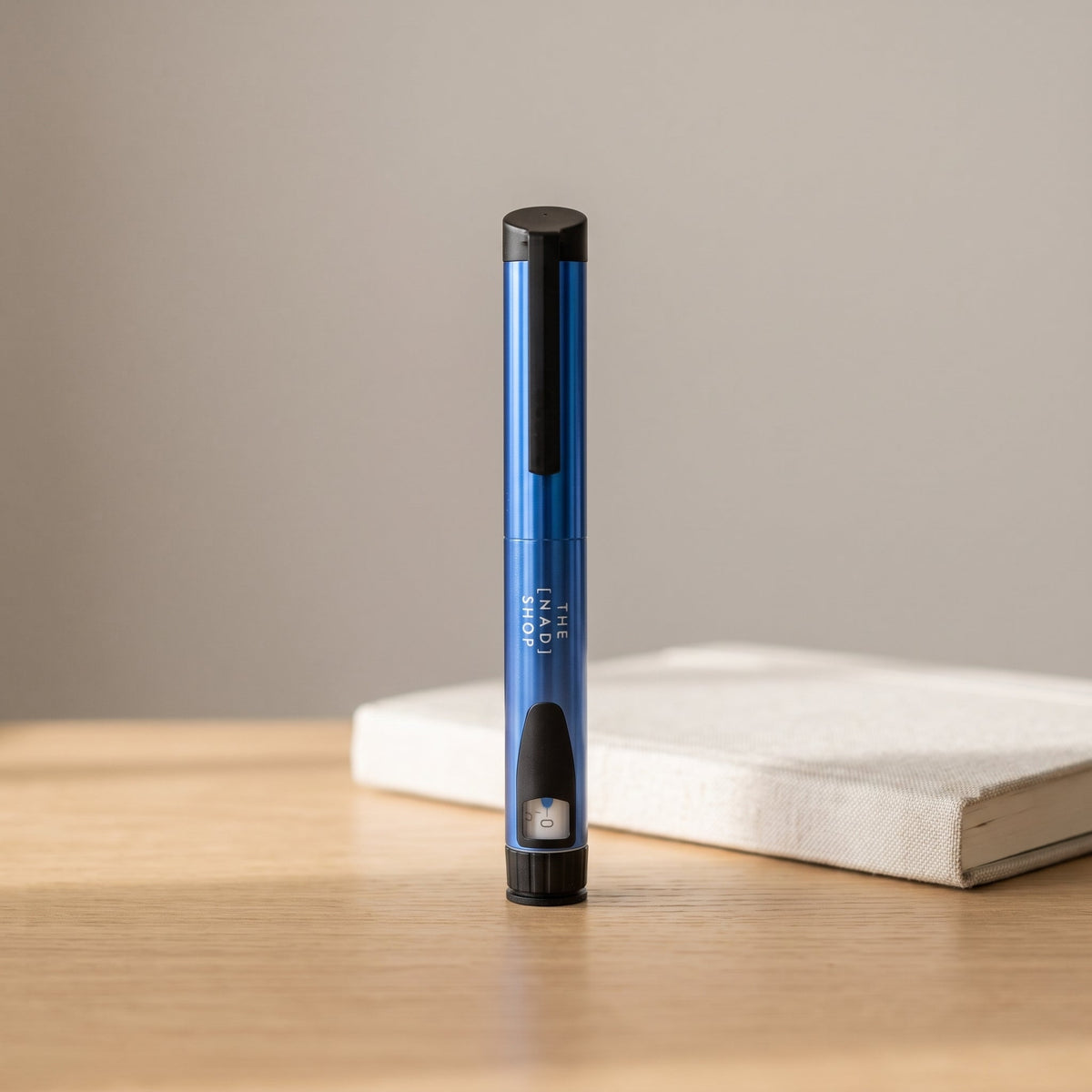
To inject NAD+ at home with a pen: wash your hands, let the cartridge reach room temperature, attach a fresh micro-needle, dial your dose, clean a patch of skin on the abdomen or thigh, pinch a fold, press the pen in at 90 degrees, hold for ten seconds, then remove the needle into a sharps bin. The whole process takes about thirty seconds once you have done it twice.
This is the guide we wish every first-time customer read before their kit arrived. It covers the equipment, the exact sequence for the auto-injector pen, the equivalent steps for vials and a syringe, where to inject and how to rotate sites, what the first week should look like, and the mistakes that cause most of the questions our support team answers. If you want the background first, read the complete UK guide to NAD+ injections.
Educational content, not medical advice. Confirm your dose and injection technique with a licensed prescriber before you start. NAD+ is for adults and is not intended to diagnose, treat, cure or prevent any disease.
What you need

- The auto-injector pen. Reusable. The dial measures the dose in millilitres; the shield covers the needle so you never see it. If yours is lost or worn out, the replacement pen is sold on its own.
- A pre-mixed NAD+ cartridge. 500mg in 3ml, which is 166.7mg per ml, fixed in every cartridge.
- Micro-needles. 32-gauge, 6mm, individually wrapped and single-use. One per injection, no exceptions.
- Prep wipes. One per injection.
- A sharps bin. Needles go straight in. Full bins can be taken to most pharmacies or collected by many councils.
Every kit we sell includes all of the above. If you only need more needles, they are sold separately.
Before you start
- Take the cartridge out of the fridge ten minutes early. Cold NAD+ stings more and absorbs more slowly. Room temperature is better; do not warm it in water or on a radiator.
- Eat something small. Mild nausea is the most common first-week complaint and it is far less likely on a settled stomach.
- Wash your hands with soap and dry them properly.
- Check the liquid. It should be clear to faintly yellow. If it is cloudy or has particles, do not use it and contact us.
- Know your dose. The reference dose is 50mg, which is 0.3ml (30 clicks) on the pen; if you want a gentler first injection, 25mg is 0.15ml (15 clicks). Use the dosage calculator to see the mark for any dose.
How to inject with the pen, step by step
- Load the cartridge. Unscrew the pen body, slide the cartridge in with the crimped metal end towards the needle end, and screw the pen back together. You only do this when a cartridge is new.
- Attach a new needle. Peel the paper tab off a micro-needle, push it straight onto the threaded tip of the cartridge and twist until snug. Remove the outer cap and keep it; remove the inner cap and discard it.
- Prime the pen. On a new cartridge, dial a small amount (about 0.05ml), point the needle upwards and press the button until a droplet appears at the tip. This clears air from the needle. You do not need to prime before every dose, only when the cartridge or needle is new.
- Dial your dose. Turn the dial until the window shows your mark: 0.3ml (30 clicks) for 50mg, or 0.15ml (15 clicks) for 25mg. The dial clicks and stops; it cannot go past what is left in the cartridge.
- Choose and clean the site. The lower abdomen, at least two finger-widths away from the navel, or the front of the thigh. Wipe the skin with a prep wipe and let it dry for a few seconds.
- Pinch and insert. Pinch a fold of skin between thumb and forefinger. Press the pen tip straight down against the fold at 90 degrees so the shield retracts and the needle enters the fat layer. You will feel a light pinch at most.
- Inject and hold. Press the button fully and keep it pressed. Count slowly to ten before removing. Removing too early is the most common reason a drop of liquid is left on the skin.
- Withdraw and dispose. Lift the pen straight out, release the skin fold, and press lightly with a clean tissue if there is a bead of blood. Replace the outer needle cap, unscrew the needle and drop it in the sharps bin.
- Store the pen. Cap it and put it back in the fridge, in its case, with the cartridge still loaded. Never store it with a needle attached.
First time, allow a couple of minutes and read each step as you go. By the third injection the sequence is automatic and takes about thirty seconds.
If you use vials and a syringe

The 2 × 1000mg vial kit works the same way, except you draw the dose yourself. Each vial holds 1000mg in 5ml, so 200mg per ml, and insulin syringes are marked in units where 100 units equals 1ml.
- Flip off the vial cap and wipe the rubber stopper with a prep wipe.
- Draw air into the syringe equal to your dose, push it into the vial, then turn the vial upside down and draw the liquid out slowly. 50mg is 25 units (0.25ml); 25mg is about 12 units.
- Tap out any air bubbles and push the plunger until the liquid is at your mark.
- Clean the site, pinch, insert at 90 degrees, inject slowly, hold five seconds, withdraw and dispose of the whole syringe in the sharps bin.
Vials are the cheapest way to buy NAD+ per milligram, but the pen is simpler for most people. If you are unsure, start with the pen.
Where to inject and how to rotate
Subcutaneous means into the fat layer, not the muscle. The two best sites are:
- Lower abdomen. Easiest to reach and see, with a reliable fat layer. Stay at least 5cm from the navel and avoid scars and stretch marks.
- Front or outer thigh. Good if you prefer not to use the abdomen. Avoid the inner thigh and the area just above the knee.
Rotate every injection. A simple method: picture the abdomen as a clock and move one hour each time, or alternate left and right, upper and lower. Injecting the same spot repeatedly causes small lumps and slows absorption.
What the first week looks like
| Day | Dose | Pen mark | Notes |
|---|---|---|---|
| 1 to 3 | 50mg (or 25mg if you prefer to start gently) | 0.3ml · 30 clicks (25mg: 0.15ml · 15 clicks) | Once a day, ideally mid-morning after breakfast. Note how you feel for the first hour. |
| 4 onwards | 50mg | 0.3ml · 30 clicks | Every other day, three or four a week. After the first month some people settle at twice a week, as agreed with your prescriber. |
Mid-morning is a good default: a late-evening dose can leave some people feeling too alert to sleep, and injecting on an empty stomach first thing makes nausea more likely. One 500mg cartridge gives roughly ten doses at 50mg, so a two-cartridge kit covers about five weeks.
What you might feel, and what to do about it
- Warmth or flushing for a few minutes. Normal. It is the NAD+ being absorbed. Sit down, breathe, it passes. If it is strong, use a smaller dose next time and inject more slowly.
- Mild nausea. Eat first; drop to 25mg for a few days.
- A small red bump or bruise. You injected a little shallow or caught a tiny vessel. Rotate sites and make sure the skin fold is pinched up properly.
- A bead of liquid on the skin after withdrawing. You removed the pen too soon. Count to ten next time. The dose you lost is small; do not inject again to make up for it.
- Nothing at all. Also normal, especially in week one. NAD+ is not a stimulant and the changes are gradual.
Stop and seek medical advice if you have hives, swelling of the face or throat, difficulty breathing, or chest pain that does not settle within minutes.
The mistakes that generate most support questions
- Reusing needles. They blunt after one use and are no longer sterile. One needle, one injection.
- Skipping the prime on a new cartridge. You inject air instead of your first dose and wonder why nothing happened.
- Storing the pen with the needle on. It lets air in and NAD+ out, and the needle is no longer sterile.
- Injecting cold. More sting, slower absorption. Ten minutes on the counter first.
- Going above 50mg early. 50mg is the reference dose; larger doses bring more flushing and no proven extra benefit. Stay at or below 100mg per injection and 500mg per week unless a prescriber says otherwise.
- Letting a cartridge sit out. NAD+ in solution degrades with heat and light. Fridge, in its case, every time.
Storage and disposal
Keep sealed and in-use cartridges and vials in the fridge at 2 to 8°C, in their case, away from light. Do not freeze. Take the dose out ten minutes before injecting. For travel, a small insulated pouch with a cold pack keeps a cartridge safe for a day or two.
Used needles and syringes go in the sharps bin immediately, never in household rubbish. When the bin is full, close the lid permanently and take it to a pharmacy that accepts sharps or arrange collection through your council's clinical waste service.
Frequently asked questions
Does injecting NAD+ hurt?
The needle is 32-gauge and 6mm, finer and shorter than those used for most vaccinations, and it enters fat rather than muscle. Most people describe a light pinch. The brief warmth afterwards is from the NAD+ itself, not the needle.
What time of day should I inject NAD+?
Mid-morning after a light breakfast suits most people. Avoid late evening if you find it makes you feel alert, and avoid a completely empty stomach, which makes mild nausea more likely.
Can I inject NAD+ into my arm?
The back of the upper arm has a usable fat layer but is awkward to pinch one-handed. The lower abdomen and front of the thigh are easier and more consistent, so we recommend those.
What if I miss a dose?
Just take the next scheduled dose. Do not double up. NAD+ works through consistency over weeks, not through any single injection.
How long does a 500mg cartridge last?
Ten doses at 50mg, or twenty at 25mg. Once opened, use it within four weeks and keep it refrigerated.