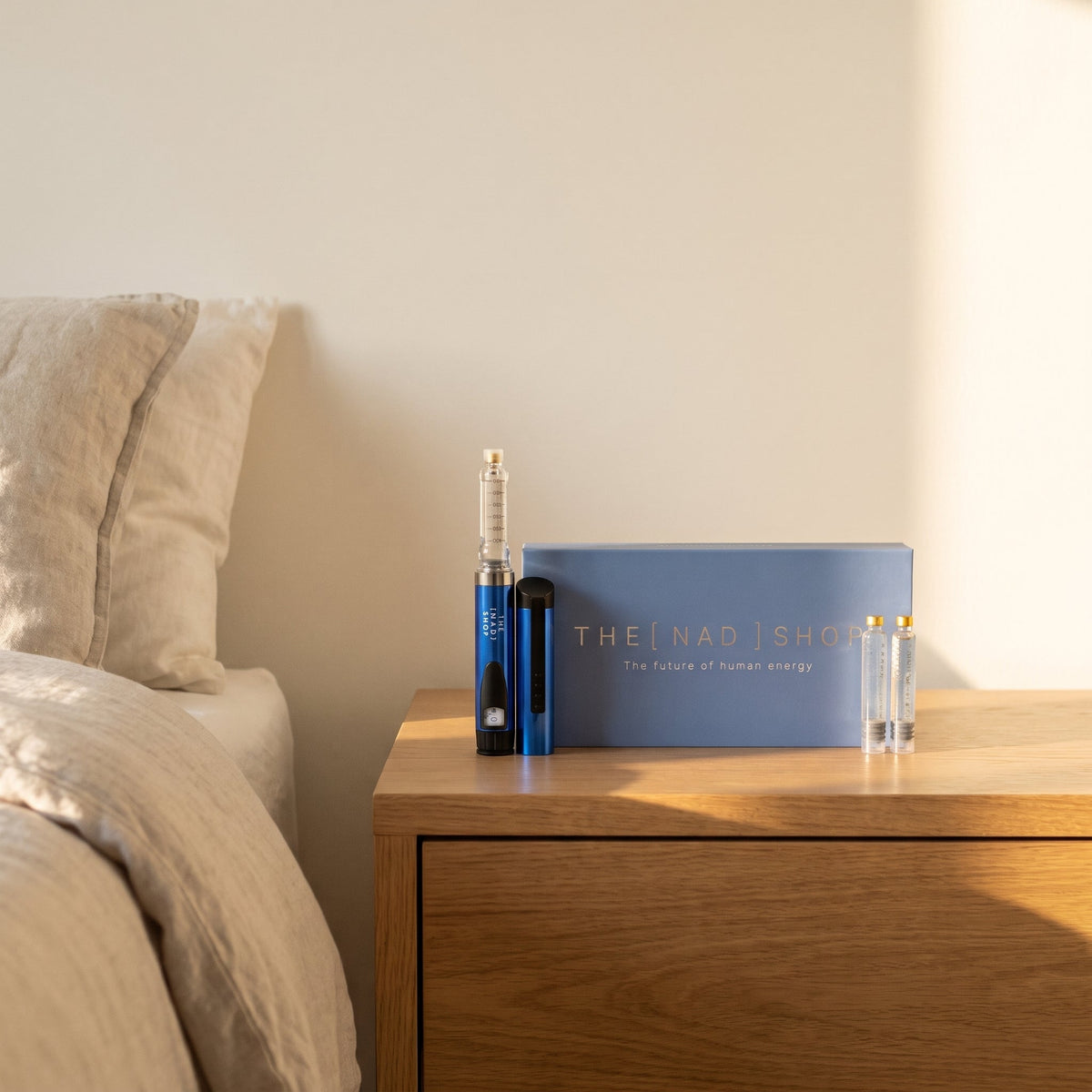
Store NAD+ cartridges and vials in the fridge at 2 to 8°C, in their box and away from light, and never freeze them. Sealed product keeps until the expiry date on the label; once a cartridge is in use, finish it within four weeks. Take each dose out ten minutes before injecting, and travel with it in an insulated pouch.
This guide is for anyone who has just received a kit, or is about to, and wants to keep every dose in good condition. It covers why NAD+ in solution needs cold storage, where it goes in the fridge, how long it lasts sealed and opened, what to do if a cartridge was left out, and how to carry it on a trip or a flight.
Educational content, not medical advice. NAD+ is not intended to diagnose, treat, cure or prevent any disease. Speak to a licensed prescriber before starting any injectable protocol, especially if you are pregnant or breastfeeding, have active or historic cancer, or take regular medication. Always follow the storage instructions printed on your product and in the quick-start guide.
Why NAD+ needs cold storage
NAD+ is a fairly delicate molecule once it is dissolved. In water it slowly breaks apart into nicotinamide and ADP-ribose, and the rate of that breakdown rises with temperature. Classic biochemistry work from the 1960s, published in the Journal of Biological Chemistry, showed that the oxidised form, NAD+, is most stable in mildly acidic solution and degrades faster when warm or alkaline. Light adds a further stress.
Our cartridges and vials are pre-mixed, which is what makes them convenient: there is no powder to reconstitute and nothing to measure. The trade-off is that the NAD+ is already in solution from the day it is filled, so temperature control matters from the moment it arrives. Cold slows the breakdown down to the point where the product keeps until its expiry date. Warmth speeds it up.
The important thing to know is that you cannot see it happening. A cartridge that has spent a day in a hot car can look exactly like one that has never left the fridge. That is why the rules below are about habits rather than inspection, and why a supplier's storage guidance is one of the things worth checking before you buy, as we explain in Is NAD+ legal in the UK?
The everyday rules
Five habits cover almost every situation:
- Fridge, 2 to 8°C. That is the normal range of a working domestic fridge. A cheap fridge thermometer tells you whether yours actually holds it; older fridges often run warmer at the top.
- Middle shelf, not the door. The door warms up every time you open it, and the back wall near the cooling plate can drop below zero. UK guidance on storing vaccines makes the same point: keep cold-chain products away from the door and the walls of the fridge.
- In the box or case. The packaging shields the solution from light, keeps the pen and cartridge together and stops anything being knocked over. The refill box is designed to be small enough to live on a fridge shelf.
- Never frozen. Freezing can damage the solution and the cartridge seal. A product that has frozen should not be used, even after it thaws.
- Back in straight after the dose. Cap the pen with the cartridge still loaded and return it to the fridge in its case. Leaving it on the worktop until the evening is the most common slip.

What goes in the fridge and what does not
Not everything in the kit needs to be cold. Only the NAD+ itself does.
| Item | Where to keep it | How long it keeps | Notes |
|---|---|---|---|
| Sealed 500mg cartridge | Fridge, 2 to 8°C, in its box | Until the expiry date on the label | A spare cartridge belongs here too |
| Cartridge in use (loaded in the pen) | Fridge, pen capped, in its case | Four weeks from the first dose | Write the start date on the box |
| Sealed 1000mg vial | Fridge, 2 to 8°C, in its box | Until the expiry date on the label | Keep upright |
| Vial in use | Fridge, in its box | As printed on the label and in the quick-start guide | Wipe the stopper before every draw |
| Micro-needles, 32G 6mm | Room temperature, out of direct sunlight | Until the date on the pack | Single use; a fresh one every dose |
| Wipes and sharps bin | Room temperature, out of reach of children | Not applicable | Close the sharps bin when it is full |
Shelf life: sealed and opened
Sealed. An unopened cartridge or vial kept in the fridge is good until the expiry date printed on its label. Check that date when the parcel arrives and use the oldest stock first if you have more than one.
Opened. A cartridge counts as opened from the first time a needle goes through its seal. From then on, use it within four weeks and keep it refrigerated between doses. On the standard 50mg protocol of daily doses for three days and then every other day, a 500mg cartridge holds ten doses and is finished in under three weeks, well inside that window. Our dosage guide sets out the full rhythm.
If you dose less often, for example two doses a week on maintenance, or you are starting on 25mg doses, a cartridge can outlast four weeks. In that case finish it at four weeks rather than stretching it. Writing the date of the first dose on the box with a pen takes two seconds and removes the guesswork.

Before each dose: from fridge to room temperature
Cold NAD+ can sting a little more on the way in, so take the pen or vial out of the fridge about ten minutes before you inject and let it reach room temperature on the worktop. That short time out is expected and is part of normal use.
Do not speed it up. Running the cartridge under hot water, leaving it on a radiator or holding it near a heater warms it unevenly and can push parts of the solution well above room temperature. Ten minutes on the side is enough. Warming it in your hand for a minute is fine.
Before every dose, look at the solution. It should be clear. If it looks cloudy, discoloured or has particles in it, do not inject it. The full routine, from attaching the needle to disposal, is in How to inject NAD+ at home with a pen.
Left it out of the fridge? What to do
It happens to almost everyone once. What matters is how long, and how warm.
- Forgotten on the worktop for an hour or so, in a cool room. Put it back in the fridge, check the solution looks clear at the next dose and carry on.
- Out overnight or for most of a day at room temperature. Message us before your next dose with the batch number from the label. We will tell you whether to keep using it.
- Exposed to real heat: a car in summer, direct sun on a windowsill, next to a radiator. Do not use it.
- Frozen, for example pushed against the back of the fridge or packed against an ice pack. Do not use it, even once it has thawed.
- Cloudy, discoloured or with particles at any point. Do not use it.
We do not give a single number of hours that is safe in every case, because the answer depends on the temperature it reached, and a kitchen in August is not a kitchen in January. When in doubt, get in touch; a person replies, and replacing a cartridge costs less than worrying about one. Using a product that has degraded is unlikely to harm you, but you may simply be injecting less NAD+ than you think, which makes it harder to judge how the protocol is working.
When your order arrives
Unpack the parcel the day it arrives and put the cartridges or vials straight into the fridge. The needles, wipes and sharps bin can go in a cupboard. If you are out when it is delivered, ask for it to be left somewhere shaded rather than on a sunny doorstep, and refrigerate it as soon as you are home. If a parcel has been sitting somewhere unusually warm for a long time, tell us before you use it.
Travelling with NAD+
A trip does not mean pausing your protocol. Most people simply take the pen with them.
- Use an insulated pouch with a cool pack. Wrap the cartridge or pen so it is not touching the cool pack directly; contact with a frozen pack can freeze the solution. Packed this way, a cartridge stays cool for a day or two.
- Hand luggage, never the hold. The hold can get cold enough to approach freezing, and checked bags can go missing. Keep the pen, cartridge and needles together in their original packaging, and check your airline's rules on carrying medical sharps before you fly.
- Find a fridge on arrival. A hotel fridge or minibar works; put the pouch on a middle shelf rather than against the back wall, where minibars often run very cold. If there is no fridge, swap in a fresh cool pack each day.
- Avoid cars and sunny rooms. A glovebox or a parked car heats up quickly, even on a mild day.
For long-haul trips, how to time doses across time zones is covered in NAD+ for sleep and jet lag.
Spares, refills and planning ahead
Good storage is easier when you are never down to your last dose. A few options:
- Starting out: the Discovery Kit includes the pen, two 500mg cartridges and everything else for about five weeks.
- A spare in the fridge: a single 500mg refill cartridge means you do not have to stretch an opened one past four weeks.
- Ongoing: the Pen Refill Kit covers one, two or three months, in a box small enough for the fridge.
The whole range is in the NAD+ collection, and the bigger picture, from what NAD+ does to how to choose a protocol, is in our complete UK guide to NAD+ injections. Delivery is free across the UK, and subscriptions can be paused or cancelled at any time.
Frequently asked questions
Does NAD+ need to be refrigerated?
Yes. Pre-mixed NAD+ cartridges and vials should be kept in the fridge at 2 to 8°C, in their box and away from light. NAD+ in solution breaks down faster when warm. Needles, wipes and the sharps bin can stay at room temperature.
How long does an opened NAD+ cartridge last?
Use an opened cartridge within four weeks of the first dose and keep it refrigerated between doses. On the standard 50mg protocol, a 500mg cartridge is finished in under three weeks. Sealed cartridges keep until the expiry date on the label.
Can NAD+ be frozen?
No. Freezing can damage the solution and the cartridge seal. Do not use a cartridge or vial that has frozen, even after it thaws, and keep it away from the back wall of the fridge and from direct contact with ice packs.
What if I left my NAD+ out of the fridge overnight?
Do not inject it until you have checked with your supplier. Message us with the batch number from the label and we will advise. A product left in real heat, such as a car or direct sun, should not be used.
How do I travel with an NAD+ pen?
Carry the pen, cartridge and needles in hand luggage in an insulated pouch with a cool pack that does not touch the cartridge directly. That keeps it cool for a day or two. Put it in a fridge as soon as you arrive.
Sources
- Lowry OH, Passonneau JV, Rock MK. The stability of pyridine nucleotides. Journal of Biological Chemistry, 1961.
- UK Health Security Agency. Storage, distribution and disposal of vaccines. Immunisation against infectious disease (the Green Book), Chapter 3.
- Covarrubias AJ et al. NAD+ metabolism and its roles in cellular processes during ageing. Nature Reviews Molecular Cell Biology, 2021.